
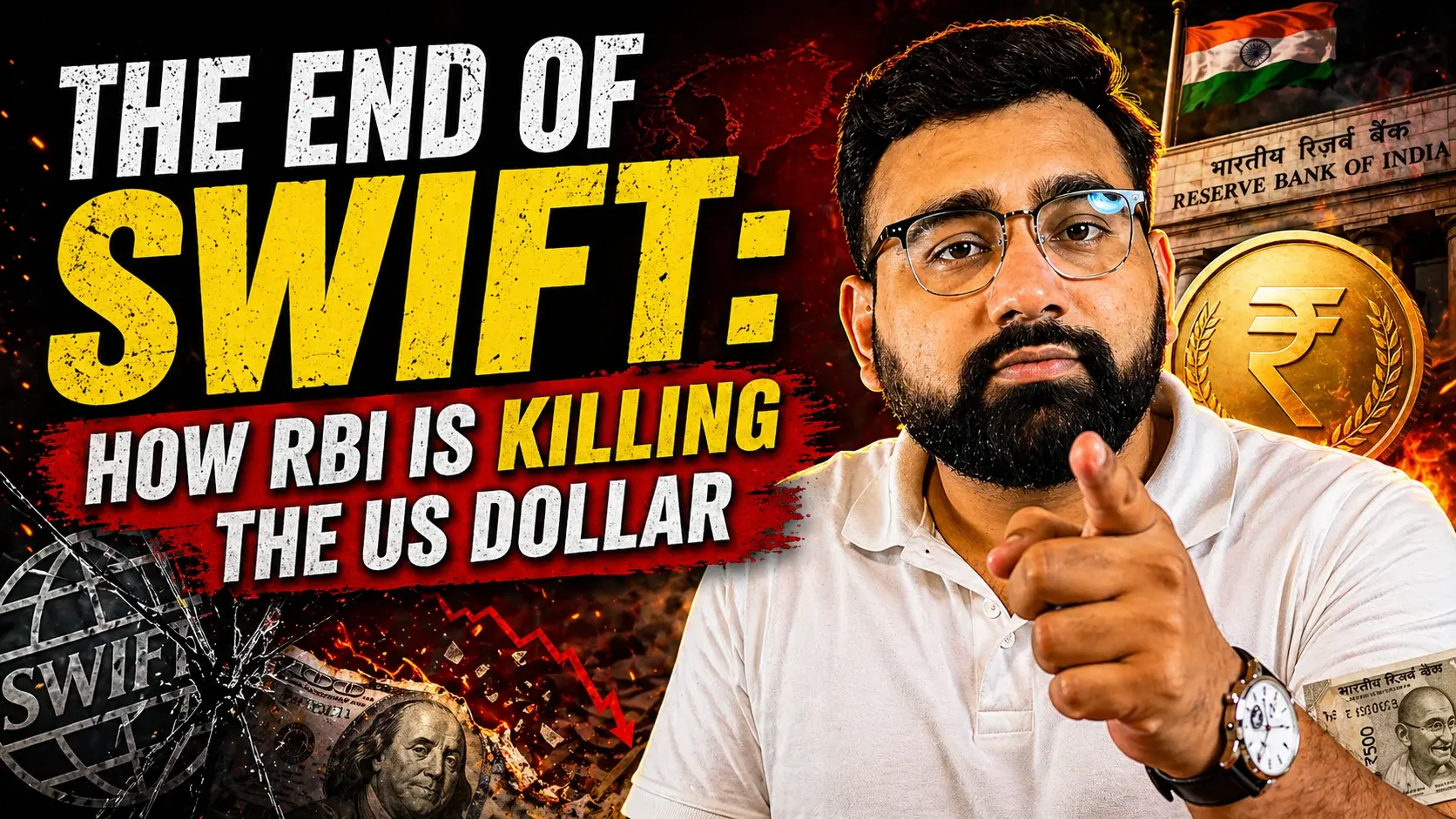
THE END OF SWIFT: HOW THE RBI IS DECOUPLING INDIA FROM THE US DOLLAR
While the world is distracted by the daily noise of stock market dips and election cycles, a silent digital revolution is gathering pace inside the Reserve Bank of India (RBI) . For over 50 years, the global economy has been controlled by a master switch called SWIFT . It is more than just a messaging system; it is a geopolitical weapon . If a nation does not follow the US Dollar’s rules, the switch gets flipped, and that country is effectively erased from the global market .
But India has finished building its own power grid . Through the mBridge project and the Digital Rupee , the RBI is staging a financial declaration of independence that could redefine the value of the Rupee forever .
THE $50,000 "HIDDEN TAX": HOW SWIFT DRAINS THE ECONOMY
To understand the urgency behind the RBI move, we have to look at the invisible toll gate that has been draining the Indian economy for decades . Every time an Indian business trades globally, they pay a tax to the US banking system .
Consider the case of a solar power manufacturer in Gujarat selling $50,000 worth of equipment to a buyer in Berlin . Logic suggests the money should travel directly from Germany to Mumbai, but that is not how SWIFT works .
The New York Stopover: The Euros are first sent to a correspondent bank in New York to be converted into USD .
The Nostro "Waiting Room": The funds sit in a Nostro account for 24 to 48 hours .
The Final Conversion: The money is converted again into Indian Rupees before being sent to Gujarat .
The Financial Damage: At every stop, a middleman takes a cut . On a $50,000 trade, businesses typically lose 1% to 3% in fees and another 2% in currency conversion . In today’s market, that is a loss of over ₹1,00,000 on a single transaction . Furthermore, the US government maintains a digital ledger of that trade and can freeze those funds at any moment .
MBRIDGE: THE "UPI-FICATION" OF GLOBAL TRADE
The RBI is not just complaining about the monopoly; they are replacing it . Enter mBridge , a multi-CBDC (Central Bank Digital Currency) platform that allows central banks to talk to each other directly, with no New York stopover required .
Flat Network: Unlike the "Hub and Spoke" model where the US is the hub, mBridge is a flat network .
Blockchain Ledger: When the RBI sends a Digital Rupee token , it travels over a blockchain-based ledger .
Instant Settlement: A recipient bank in Dubai or Bangkok sees the token and instantly settles it in their local currency .
This transformation moves global trade settlement from 3 days to 3 seconds , with transaction fees dropping from $50 to nearly zero . This is the UPI-fication of global trade .
THE MATHEMATICAL CERTAINTY OF $1 = ₹3
The provocative forecast of a 3-Rupee Dollar is a mathematical outcome of bypassing the "Dollar Tax" . When India buys oil from the UAE or electronics from Taiwan using this direct system, the global demand for the US Dollar drops . Basic economics dictates that lower demand equals a lower value for the dollar .
TIMELINE: WHEN WILL THIS HIT YOUR BUSINESS?
The friction of international business is dying . While the mBridge project has already settled $5 Billion in its pilot phase, the rollout will follow a strategic path :
Phase 1 (Current): Large-scale institutional and Wholesale settlements .
Phase 2 (2025-2026): Expansion to major exporters and SME trade .
Phase 3 (2027): Full Retail integration , allowing a solo entrepreneur in Pune to receive a payment from Brazil as easily as a UPI payment from the shop downstairs .
CONCLUSION
The bridge is built . The data surfacing this month confirms the shift: the RBI has signed a historic MoU with 30 nations to bypass SWIFT, and even the US Treasury Secretary has warned that sanctions are losing power as digital alternatives rise . The question is whether you will be the one crossing that bridge or the one left behind in the old world .
RESEARCH RESOURCES
Official Reports: Bank for International Settlements (BIS) mBridge Project MVP Update
Institutional Data: Reserve Bank of India Digital Rupee Concept Note
Government Analysis: U.S. Department of the Treasury Sanctions Efficacy Report

Leave a comment
Your email address will not be published. Required fields are marked *